

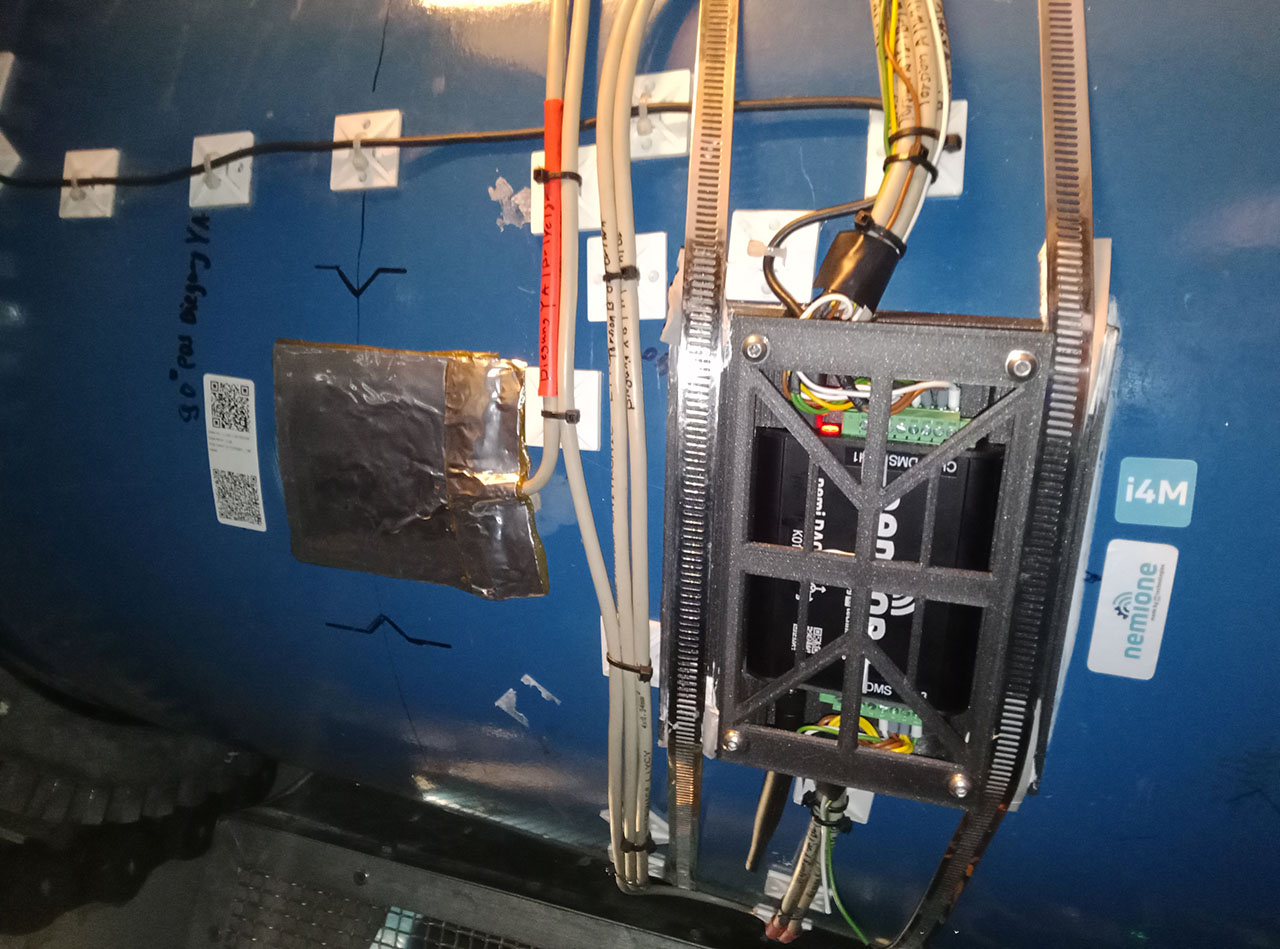
Strains and forces are among the most important measured variables when parts, structures or components are to be assessed under real operating conditions. On moving or rotating parts in particular, however, measurement is demanding. Inductive transmission paths are often sensitive; cables can influence the movement, wear out, or can only be used with slip rings and additional mechanical effort. Wireless sensor technology enables measurement directly in the load path and under real conditions of use. In this way, loads can be reliably captured, validated and documented.
For torque measurement, strain gauges are applied as a full bridge directly to the existing shaft and connected to nemi DAQ or nemi DAQ nano. The module rotates with the shaft and transmits the measured values wirelessly with 24-bit resolution. A slip ring or inductive transmission is not needed: nemi DAQ combines strain gauge measuring amplifier and telemetry in one compact housing. In this way, you measure torques on the original shaft, even where there is no installation space for a torque measuring shaft. The integrated IMU captures rotational speed and rotation angle synchronously with the torque, for example on test benches, in structural durability testing and when determining load spectra in field tests.
Strain, force and torque are captured where the load path and strain level offer optimal measurement conditions. Short signal paths and the absence of long cables also reduce potential electromagnetic interference.
Slip rings, elaborate cable runs and inductive transmission systems can be dispensed with. The long wireless range enables reliable data transmission even over greater distances.
Measure not only on the test bench, but directly under real conditions of use and operation. Thanks to buffered wireless transmission, all captured samples are retained even during brief interruptions of the wireless connection.
Low noise, 24-bit resolution and sampling rates of up to 6.4 kHz enable high signal quality and temporal resolution. This allows FEM, test bench and field data to be compared and validated meaningfully.
Strain gauges, force, torque, rotation angle, acceleration, rotation rate and temperature can be flexibly linked with one another and analysed time-synchronously.
Suitable for development tests, endurance runs, commissioning, field tests and continuous monitoring. The low power consumption and long battery runtime enable long periods of use with little maintenance effort.
With our wireless measurement systems – for example the nemi DAQ – we support you with questions such as:
Which strains occur under real loads?
Which forces and torques act on components and assemblies during operation?
Do simulation, test bench and field measurement agree?
Do load peaks, overloads or critical operating states occur?
How does the load change depending on power, speed, temperature or operating mode?
Which limit values make sense, and how can they be monitored and documented reliably?
Which measuring points provide the most meaningful results?
Which sampling rates are sufficient for good signal quality?
IFW Hannover
Machine tool
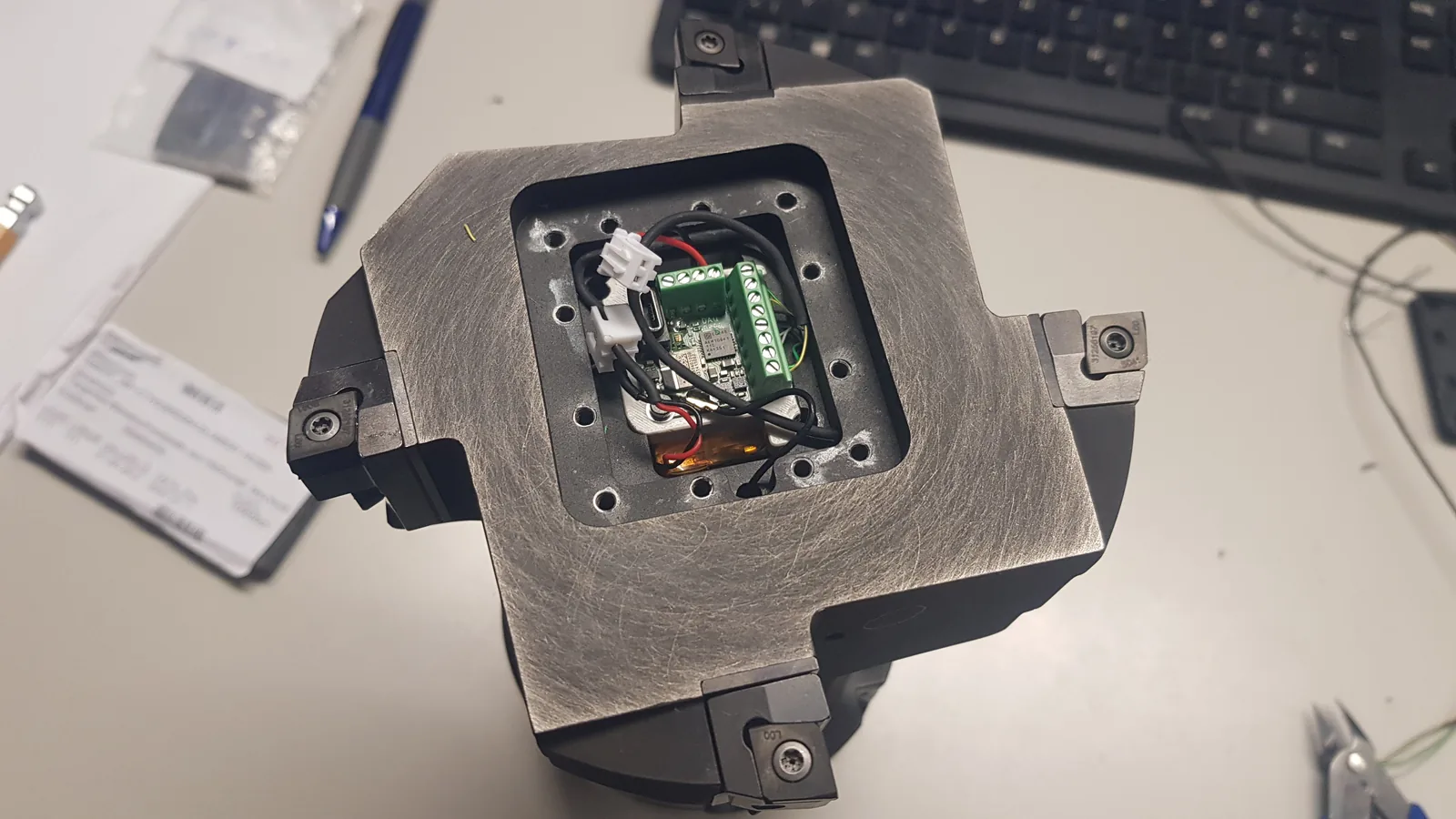
For the IFW at Leibniz University Hannover, a telemetry system powered by a rechargeable battery and fully integrated into the grinding spindle was created, which is charged at standstill between workpieces. It transmits reliably out of the rotating spindle and detects process forces close to the point of action – without additional, cost-intensive measurement technology.
Further fields of application
Strain measurement on shafts, axles, couplings or rotating components
Force measurement on moving components, joints or bearing points
Load spectrum acquisition in real use as a basis for digital twins
Validation of FEM or simulation models
Monitoring of component loads during commissioning or endurance runs
Dynamic strains, forces and load peaks are transmitted live in 24-bit resolution with low latency.
Each sensor node keeps a precise clock that is continuously synchronised with the receiver’s master clock via the wireless protocol. Every data packet carries this timestamp with microsecond resolution at the time of measurement. In this way, strain and force signals can be correlated exactly with rotation angle, rotational speed or further channels – without an external time reference.
During rotation, the antenna can be briefly shadowed. The receiver acknowledges every packet; packets that cannot be transmitted are buffered by the node and resent after reconnection. Interruptions of seconds to minutes are bridged – no load event is lost.
Selectable between range and bandwidth – from 20 m (indoors, 2 Mbit/s) to 350 m (urban outdoor environment, 125 kbit/s). Higher speeds deliver more measurement bandwidth and better energy efficiency per sample over short distances; lower speeds deliver more range and link budget.

Strain gauges

Strain gauge full bridges

Force sensors

Displacement and distance sensors

Temperature sensors

Pressure sensors

analogue sensors with voltage or current output

Torque transducers
Sensor
Wireless transmission
Flexible wireless for measurement data
Gateway
USB receiver or gateway with edge computing
Data processing
Locally on the measurement PC or in the cloud
Analysis
incl. alarm, key figures, FFT & SMS
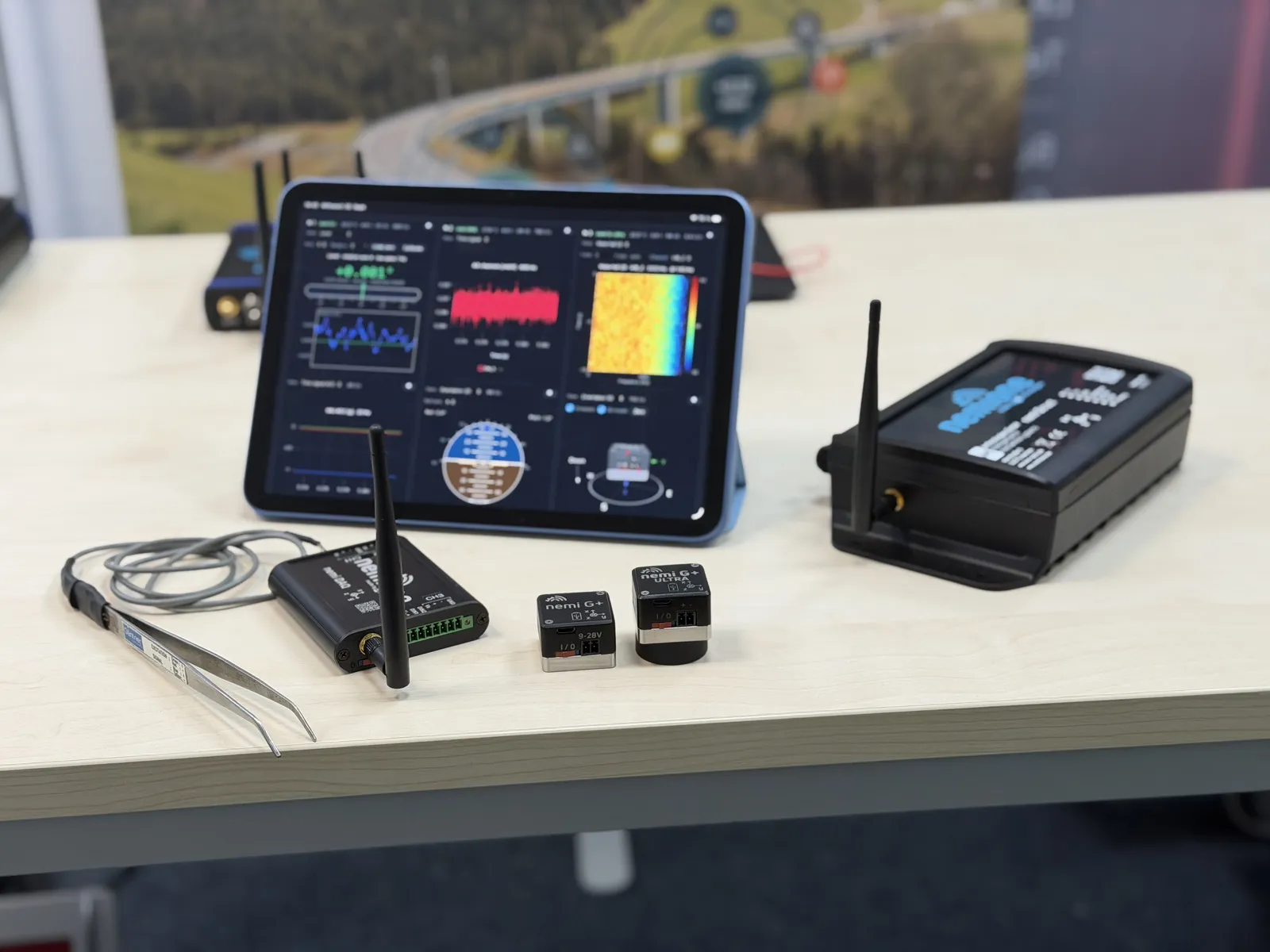
On request, the measurement does not end at the sensor. We offer an end-to-end data pipeline for acquisition, transmission, storage, live analysis and downstream evaluation of the measurement data from our wireless sensors and nodes.
The measurement data is captured from the sensor via the wireless infrastructure and can be transmitted securely to central systems via gateways such as nemi EdgeBase or nemi Log over worldwide cellular connections. Protected VPN access enables the secure connection of distributed setups.
For ongoing operation, software solutions are available for displaying live measurement data and for real-time analysis. Measured values, characteristic values, frequency content and status information can be visualised and assessed directly during the measurement.
Raw time data can additionally be stored long-term and reused for detailed analyses. Our analysis software enables, among other things, plotting, time-history analyses, FFT and frequency analyses, as well as the targeted examination of individual measurement sections and events. For long-term monitoring applications, time-aggregated (e.g. per 5 minutes) characteristic values and status data can be stored in a time-series database and visualised via an interactive dashboard. In this way, current states, historical developments, trends and anomalies can be monitored centrally.
Our systems can be flexibly integrated into existing data and software landscapes. Via Python APIs, MQTT and open data formats, customers can directly connect their own analyses, dashboards, automations or backend systems. In this way, data sovereignty remains with the user, and our platform can be used both as a complete solution and as an open building block within existing infrastructures.
nemione® is a trademark of
i4M technologies GmbH
Försterstraße 5
52072 Aachen
+49 241 56 00 22 00
sales@nemi.one